
A Smart Guide to Choosing Capital Market Investment
Sahabat Profits, as a capital market investor, you need to understand that every capital market investment product has distinct risk and return characteristics. By understanding both, investors can determine the investment option that best suits your risk profile and financial goals. Therefore, let’s find out together the risks and returns of stocks, bonds, mutual funds, and derivative investment products.
- Stocks
Investors who choose to invest in stocks in this investment product will receive returns in the form of:
- Large potential long-term returns.
- A capital gain occurs when the selling price exceeds the purchase price.
- When a company makes a profit, some of its net income is distributed to investors in the form of dividends.
In the meantime, stock investments carry the following risks:
- Capital loss is the opposite of capital gain. If capital gain is the difference between the high selling price, then capital loss is the share price that drops below the purchase price.
- No dividends, as not all businesses do. One of the reasons for this could be the use of net profit for expansion.
- Delisting companies. If delisted, the company leaves the stock exchange for various reasons, such as bankruptcy or going private.
The risk profile of stock investing is comparatively high, based on the risk and return mentioned above. As a result, stock investment products are appropriate for investors who are willing to tolerate price swings in exchange for the possibility of significant returns.
Risk Profile: ★★★★☆ or 4/5.
- Bonds
Investing in bonds has a more measurable risk profile than stocks. The returns that investors receive are:
- Receiving fixed income in the form of coupons on a periodic basis, depending on the type of bond purchased.
- Capital gain is the difference between the purchase price of the bond which is higher than the selling price.
- Low default risk, especially since the state guarantees state-owned bonds. This is due to the fact that bonds are available in a variety of series, including corporate and government bonds.
What about the risks that investors take on, even though they are regarded as structured?
Risks to be mindful of include:
- Investors may face default if the bond issuer is unable to pay the coupon and principal when due.
- Bond values fluctuate inversely, meaning that if interest rates drop, bond values will rise, and if interest rates rise, bond values will fall.
- There is a liquidity risk when stock market buyers tend to be in the majority.
- Bonds are not easily sold on the secondary market.
Therefore, the risk profile of bonds is moderate and suitable for investors who want a fixed income with more measurable risks than stocks.
Risk Profile: ★★★☆☆ or 3/5.
- Mutual Funds
The mutual fund market offers a wide range of options, making mutual funds a popular choice for both novice and expert investors. Mutual funds are considered investment instruments, not taxable objects, as taxes are already included in the portfolio’s assets. In addition, mutual funds provide other returns, including:
- Investors can now monitor mutual fund market movements more easily through various investment applications. One of them is PROFITS Anywhere, a platform owned by Phintraco Sekuritas that allows real-time portfolio monitoring anytime and anywhere.
- Having a service provider or intermediary that professionally manages the investment capital of prospective investors. So, novice investors don’t need to worry because professionals will help them consult on their capital.
- There is an increase in Net Asset Value (NAV) due to the improved performance of assets in the mutual fund portfolio.
- Investors’ funds are deposited in a custodian bank by the investment manager, thereby minimizing risk and increasing potential profits.
Risk Profile: ★★☆☆☆ atau 2/5.
- Derivatives
Indonesia’s derivative market activity has grown significantly in recent years. According to research conducted in 2025, the total amount of transactions in the derivative market as of April 30, 2025, was Rp. 1,050 trillion, or 1.13 million lots. This increase shows how investors are becoming more interested in securities whose value is based on underlying assets like stocks, bonds, or commodities. So, what are the returns on derivative investment products?
- Two-way trading, where an experienced investor will understand the market when taking a long or short position. This requires expertise in analyzing market movements so that investors can take steps to buy or sell their stock instruments.
- To invest in derivative products, investors only need to provide 10% of the capital.
- With leverage, investors can generate large returns with small capital.
- It can be used to protect the value of investments, known as hedging.
- Returns can be realized in a short period of time (T+1).
However, despite their profit potential, derivative investment products are more complex and carry higher risks than conventional instruments such as mutual funds. Due to the high-risk profile of these products, the risks involved include:
- No dividends, because investors purchase derivative products from stocks rather than purchasing the stocks directly.
- Liquidity risk, where there will not always be buyers and sellers at the same time.
- Capital loss due to incorrect analysis calculations, resulting in hedging that can cause losses.
Margin calls and forced liquidation if price movement expectations do not meet a certain percentage. This can result in the portfolio position being forcibly closed by the securities firm.
Therefore, this instrument is generally more suitable for experienced investors who understand market mechanisms and are able to manage high fluctuation risks. This is because the risk profile of derivative investment products is very high.
Risk Profile: ★★★★★ or 5/5.
However, despite their profit potential, derivative investment products are more complex and carry higher risks than conventional instruments such as mutual funds. Due to the high-risk profile of these products, the risks involved include:
- No dividends, because investors purchase derivative products from stocks rather than purchasing the stocks directly.
- Liquidity risk, where there will not always be buyers and sellers at the same time.
- Capital loss due to incorrect analysis calculations, resulting in hedging that can cause losses.
- Margin calls and forced liquidation if price movement expectations do not meet a certain percentage. This can result in the portfolio position being forcibly closed by the securities firm.
Therefore, this instrument is generally more suitable for experienced investors who understand market mechanisms and can manage high fluctuation risks. This is because the risk profile of derivative investment products is very high.
Risk Profile: ★★★★★ or 5/5.
In conclusion, there are risks and possible returns associated with each investment product, including:
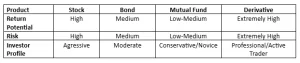
Those are the various potential benefits and risks of each investment product. Want to know more about stocks and other investment products? Visit the Education section on the Phintraco Sekuritas website.
Writer: Riska Novi Cahyani
Editor: Salsabila Wardhani & Yundira Putri Rahmadianti